
Why is there such a huge difference in effectiveness when it comes to activated carbon?
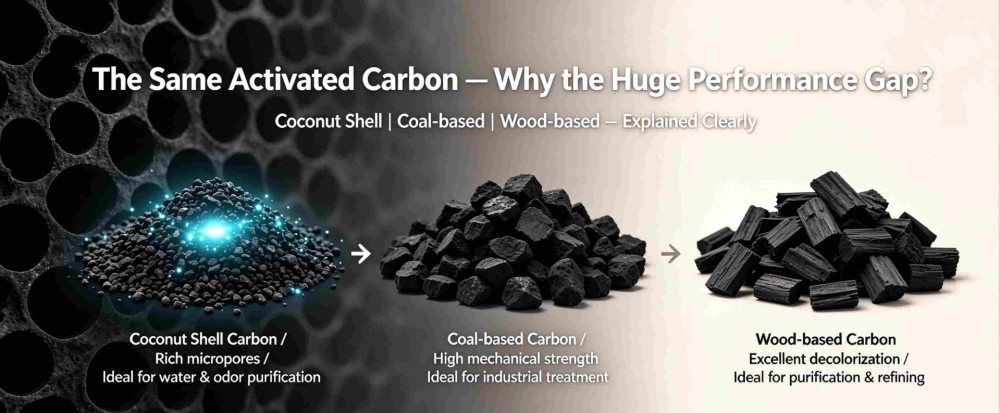
Whether it's household air purifying water filtration, laboratory decolorization, or industrial wastewater and exhaust gas treatment, activated carbon is a necessary consumable. Many people mistakenly believe that all activated carbon is the same and can be purchased randomly. In fact, the performance of activated carbon is determined by the raw material. Coconut shell carbon, coal-based carbon, and wood-based carbon vary greatly in terms of pore structure, adsorption capacity, application scenarios, and cost. Choosing the wrong one not only leads to poor results but also increases the cost of consumables.
Activated carbon adsorption relies on internal pores: micropores capture small molecules, mesopores are responsible for mass transfer, and macropores retain large molecular impurities. The pore distribution of these three types of carbon is inherently different.
Coconut shell activated carbon: Made by activating coconut shells at high temperatures, it has well-developed and uniform micropores, low ash content, and is not prone to powder shedding. It has the strongest adsorption capacity for small molecules. It is suitable for household water purifiers, fish tank filtration, new house air purification, and odor removal. However, its disadvantage is that the price is relatively high. It has weak ability to treat large molecules of pigments and is not suitable for large-scale industrial processing.
Coal-based activated carbon: Produced by processing and activating anthracite. It has a high proportion of mesopores and macropores, high mechanical strength, resistance to erosion, and is renewable. It has a high cost-performance ratio. It is mainly used for removing industrial waste gas, spray paint odors, municipal sewage, COD, and large-scale water treatment. Its drawbacks are a relatively small number of micropores, average fine adsorption performance, high ash content, and it is not suitable for high-end water purification.
Wood-based activated carbon: The raw material is wood chips and bamboo. It has abundant medium and large pores, and outstanding de-colorization and de-turbidity capabilities. It is specially used in the food, pharmaceutical, and dyeing industries. It is used for purifying syrup and medicinal liquid, and removing color and turbidity from wastewater. Its disadvantage is that the texture is relatively soft, making it prone to breaking and losing powder. It is not resistant to high-pressure flushing and has a price that is moderately high.
Simple water test to determine quality: When coconut shell charcoal is immersed in water, it continuously produces fine bubbles and the water remains clear; coal-based charcoal has sparse bubbles and is prone to slight dust falling off; wood-based charcoal has uneven bubbles and the water body is likely to become turbid.
There is no best activated carbon; only activated carbon that is suitable for the specific scenario. Choosing the right raw material can not only enhance the purification effect but also save the cost of consumables.
Leave your requirements, and Guangyuan Carbonite will provide you with a one-stop solution to select the most suitable activated carbon.
· Fujian Guangyuan Carbon Products Co.,Ltd.