
How to Judge the Abrasion Resistance of Gold Extraction Activated Carbon
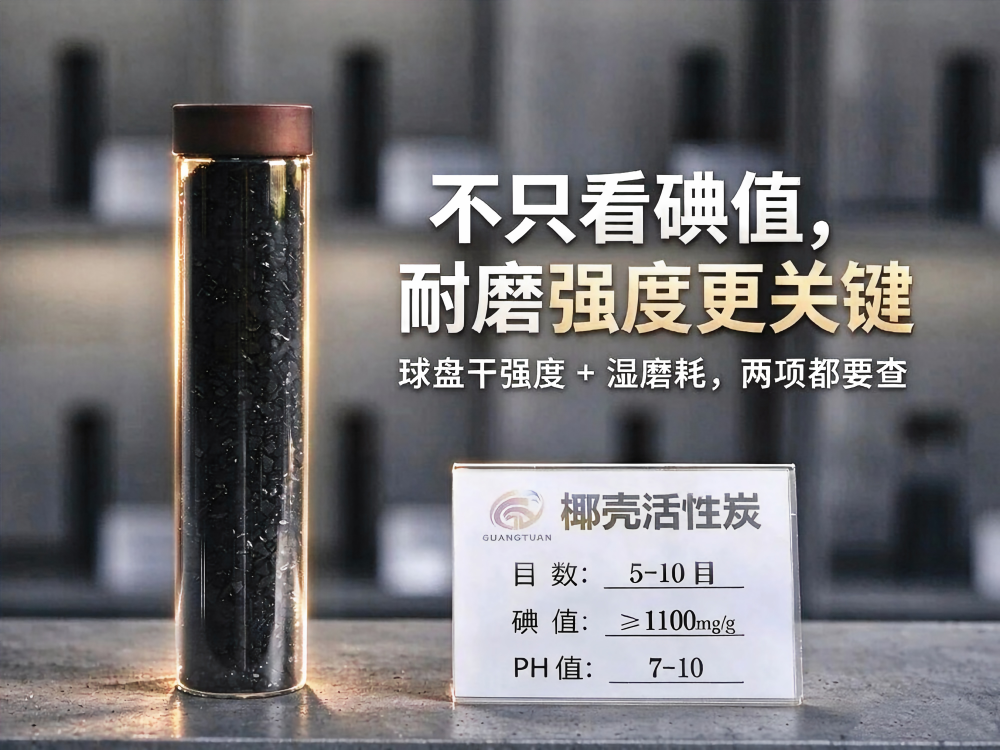
Many mines only focus on the iodine value when purchasing gold extraction carbon while ignoring abrasion resistance. In CIP and CIL processes, activated carbon undergoes repeated stirring, conveying, screening, acid washing and high-temperature regeneration. Poor abrasion resistance will cause carbon granules to pulverize easily, resulting in gold loss and higher carbon consumption.
Abrasion resistance refers to the capacity of carbon granules to resist friction, impact and thermal shock without pulverization. It can be evaluated from three dimensions:
1. Standard Laboratory Tests (For report issuance & benchmark comparison)
Tumbler dry strength (refer to GB/T 7702.3, ASTM D3802): Premium coconut shell carbon ≥98%, qualified product ≥97%. If below 96%, it carries a high risk of pulverization during long-term circulation.
Wet abrasion loss (YS/T 3038-2020, simulating real slurry conditions): Grade 1≤2.3%, Grade 2≤2.6%, Grade 3≤3.0%.
When checking the COA certificate, confirm the listed test method. Strength figures without specified test standards cannot be compared.
2. Quick On-site Screening (For reference only, cannot replace standard lab testing)
You can run simple comparisons after delivery: Rub the carbon granules. High-quality carbon only releases a small amount of dust and stays intact; low-grade carbon crumbles and sheds plenty of powder with light rubbing.
You may also test samples of equal weight, add clean water, seal and shake vigorously. Less fine powder after screening means better abrasion resistance. Another way is water soaking: carbon with poor strength has a loose structure and keeps releasing powder with slight shaking. Please distinguish inherent dust from newly generated powder caused by friction.
3. Long-term Field Performance Verification (Most valuable reference)
Lab data is only for reference; actual circulation performance on site matters most. After putting carbon into service, keep track of carbon fines in tailings and carbon make-up consumption. Retest the strength after desorption and high-temperature regeneration.
Some carbon shows good dry strength in lab tests, yet tends to crack under thermal shock during regeneration, with strength dropping sharply after repeated cycles. It is recommended to run parallel tests against your existing carbon to monitor long-term pulverization difference.
Purchasing Tips
Do not judge quality only by a high iodine value. Excessively high iodine value often comes at the cost of compact structure and weaker abrasion resistance. For procurement, check dry strength + wet abrasion loss together. Wet abrasion loss is more consistent with gold extraction working conditions.
· Fujian Guangyuan Carbon Products Co.,Ltd.