
Comparison of three types of charcoal gold extraction - coconut shell vs palm shell vs fruit shell
I. Introduction to Three Kinds of Charcoal
1. Coconut shell charcoal (high-end preferred)
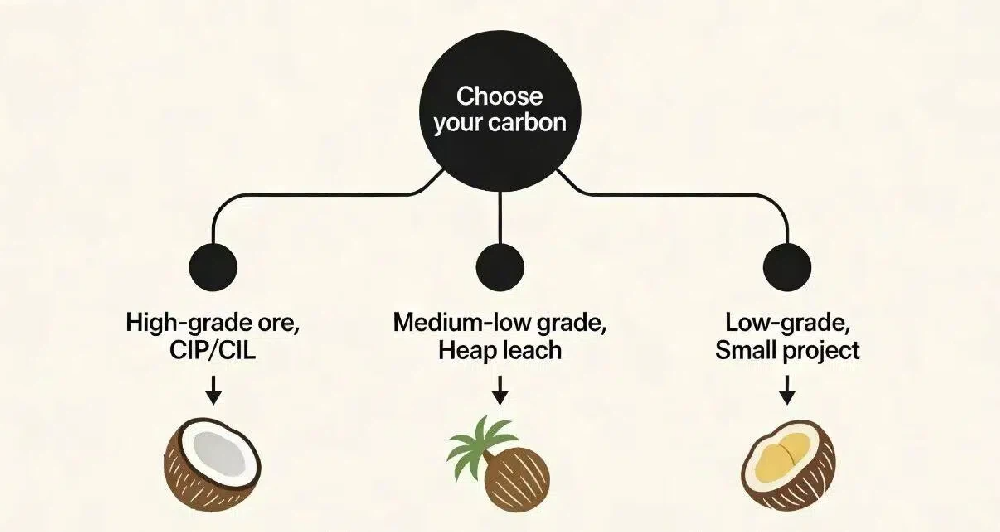
Price: 24,000 - 35,000 yuan/ton, iodine value: 1000 - 1200 mg/g, strength: ≥98% (wear-resistant and durable),Ash content: ≤3% (few impurities), adsorption rate: 98%+, gold loading: 6000g/t, cycle times: 6 - 8 times,Each loss: 5 - 7%, suitable for: CIP/CIL, high-grade ores, continuous production
2. Palm shell charcoal (mid-range cost performance)
Price: 14,000 - 25,000 yuan/ton, iodine value: 900 - 1,000 mg/g, strength: ≥95% (weaker than coconut shell),Ash content: ≤4%, adsorption rate: 95 - 97%, gold loading: 5,000 - 5,800g/t, cycle times: 4 - 6 times,Loss: 8 - 10%. Suitable for: medium and low-grade ores, heap leaching, limited budget.
3. Activated carbon (entry-level)
Price: 11,000 - 21,000 yuan/ton, iodine value: 850 - 1000 mg/g, strength: ≥92% (easily powderized),Ash content: ≤5% (contaminants are abundant), adsorption rate: 90 - 93%, gold loading: 4000 - 5000g/t, cycle times: 2 - 3 times, loss: 12 - 15%. Compatibility: low-grade ores, small-scale heap leaching, temporary projects.
II. The Differences Among the Three Types of Charcoal
1.Pore structure (determining the efficiency of gold absorption)
Coconut shell charcoal: A perfect golden ratio of micropores and mesopores, with pore diameters ranging from 1 to 2 nanometers, perfectly matching the gold-cyanide complex (0.5 nanometers). It absorbs quickly, absorbs a lot, and holds the absorption firmly.
Palm shell charcoal: It has more medium pores and fewer micropores, with slow adsorption speed and low gold loading capacity. However, it is better than fruit shell charcoal.
Fruit shell charcoal: It has more large pores and fewer micropores, with low adsorption capacity and poor selectivity. It is prone to absorbing impurities.
2. Strength and Lifespan
Coconut shell charcoal: Naturally dense, it does not break or powderize during stirring, desorption, or regeneration. It lasts long and has low wear and tear.
Palm shell charcoal: Medium strength. It is prone to wear during long-term stirring. It has a short lifespan and high wear and tear.
Fruit shell charcoal: Low in hardness. It breaks easily upon stirring and powderizes upon washing. The powderized charcoal is lost along with the mineral slurry, and the gold is lost along with it.
3. Ash and Impurities
Coconut shell charcoal: Low ash content and few impurities. After desorption, the gold purity is high and subsequent purification is simple.
Palm shell charcoal: Medium ash content, slightly more impurities. Desorption rate is 93–95%.
Nut shell charcoal: High ash content and many impurities. Desorption rate is 90–92%, with low gold purity and high purification cost.
4. Price and Total Cost
Coconut shell charcoal: Expensive but cost-effective. The value of single adsorption of gold is 12-150,000 yuan per ton. With 6-8 cycles, the overall cost is the lowest.
Palm shell charcoal: Moderate. Cheaper than coconut shell, but shorter lifespan and higher loss. The overall cost is medium.
Fruit shell charcoal: Cheap but loss-making. The single adsorption of gold is less, the loss is high, and the cycles are few. The overall cost is the highest.
Gold extraction uses coconut shell charcoal as the top-level standard product. Palm shell charcoal is the mid-range product with good cost-effectiveness. Fruit shell charcoal is the low-end entry-level product. Guangyuan Carbon is dedicated to producing 100% coconut shell charcoal, using the best coconut shell carbonized materials from Southeast Asia. For extracting gold, Guangyuan coconut shell charcoal is the choice, achieving twice the result with half the effort!
· Fujian Guangyuan Carbon Products Co.,Ltd.